

Bali Real Estate Development Strategy

Introduction
A comprehensive Bali Real Estate Development Strategy is the central principle behind any successful property investment endeavor.
In practice, underperformance is rarely caused by poor execution alone. More often, it originates from early-stage misalignment between asset definition, market positioning, and cost structure. Once these misalignments are embedded into a project, they are difficult, if not impossible to correct without eroding returns.
Professional developers approach this differently.
They treat development as a structured process, where each decision is validated, sequenced, and aligned with a clearly defined outcome. This begins with a complete Investment Advisory approach, starting with a rigorous due diligence, ensuring the land, legal framework, and constraints are fully understood and culminates in feasibility analysis, where financial viability is confirmed before capital is deployed.
Between these two points lies strategy.
This article outlines the the second step of our Real Estate Investment Advisory and Best Practices.
Asset Class Determination
Asset class determination is the first and most consequential decision within any Bali Real Estate Development Strategy. It establishes the commercial foundation upon which all subsequent decisions are built. While often approached from a design or lifestyle perspective, in professional development practice it is fundamentally a financial exercise—one that defines the relationship between market demand, pricing tolerance, and cost structure.
In markets such as Bali, where micro-location dynamics and buyer profiles vary significantly, selecting the wrong asset class can create structural inefficiencies that cannot be corrected later. A product that is misaligned with its market will struggle to achieve pricing targets, experience slower absorption, and ultimately deliver suboptimal returns. Conversely, a well-selected asset class creates alignment across design, cost, and revenue, allowing the project to operate efficiently from concept through completion.
This is why experienced developers begin with disciplined analysis rather than assumptions. Asset class is not chosen based on preference—it is selected based on evidence.
The chosen asset class defines:
- Target buyer or tenant profile
- Revenue model (rental yield, resale, hybrid)
- Design parameters and specifications
- Cost thresholds and margin expectations
- Exit strategy and liquidity
Key Strategic Filters
Factor | Core Question | Impact |
Market Depth | Is demand sustainable at this level? | Reduces vacancy risk |
Competitive Supply | What comparable assets exist? | Defines positioning |
Price Elasticity | How sensitive is demand to pricing? | Sets cost ceiling |
Operational Complexity | What is required post-handover? | Impacts ROI |
Integration with Due Diligence
- Asset class decisions should not be made in isolation.
- They must be informed by early-stage due diligence, particularly zoning, build-ability, and site constraints.
- A mismatch between intended asset class and regulatory reality is one of the most common causes of project failure.
Strategic Insight
- Misclassification at this stage introduces structural inefficiencies that cascade through design, cost, and market performance.
Commercial Spatial Allocations
Commercial spatial allocation is one of the most underappreciated drivers of financial performance in real estate development. While often perceived as a design exercise, it is in reality a capital allocation decision that directly impacts revenue efficiency, cost distribution, and long-term asset performance.
Every square meter within a project carries both a cost and an opportunity. Space allocated to non-revenue-generating functions must be justified by its contribution to pricing power, user experience, or operational efficiency. When this balance is not actively managed, developments tend to accumulate inefficiencies—oversized circulation areas, underutilized amenities, or poorly planned service zones—that reduce net sellable or rentable area without delivering proportional value.
In high-growth but inconsistent markets such as Bali, these inefficiencies are amplified. Construction costs remain sensitive, while pricing ceilings are dictated by market absorption capacity. As a result, spatial discipline becomes essential. Projects that optimize allocation early achieve stronger financial outcomes without requiring additional capital investment.
Allocation Priorities
- Saleable or rentable areas (primary revenue drivers)
- Strategic amenities (only where ROI is measurable)
- Circulation and service areas (optimized for efficiency)
Benchmark Allocation
Space Type | Target Range (% of Total GFA) |
Saleable / Rentable Area | 65–75% |
Amenities | 10–20% |
Circulation / Services | 10–15% |
Common Failure Points
- Over-investment in low-utilization amenities
- Inefficient circulation layouts
- Insufficient back-of-house planning
Integration with Feasibility
- Spatial inefficiencies directly reduce net sellable area, which impacts revenue projections and overall project feasibility.
- These effects are often underestimated during early design stages.
Strategic Insight
- Poor spatial discipline is one of the most effective ways to reduce profitability without immediate visibility.
Market Tiering & Positioning


Market tiering and positioning define how a development is perceived, priced, and ultimately absorbed by the market. While many projects focus heavily on physical design, it is positioning that determines whether that design can be successfully translated into financial performance.
In practical terms, positioning is the alignment between product, pricing, and target buyer. It establishes expectations and creates the framework through which value is communicated and measured. In a fragmented and rapidly evolving market like Bali, where demand spans from yield-focused investors to experience-driven lifestyle buyers, clarity of positioning is critical.
Projects that lack this clarity often attempt to appeal to multiple segments simultaneously, resulting in diluted identity and inconsistent pricing. This hybrid approach typically leads to slower sales cycles and reduced pricing power. By contrast, developments that commit to a clearly defined tier are able to align all aspects of the project—design, amenities, branding, and operations—into a coherent offering that resonates with a specific market segment.
Positioning defines how a project is perceived, priced, and ultimately absorbed by the market. A clear Real Estate Development Strategy requires selecting a target market tier and aligning all project elements accordingly.
Tier Framework
Tier | Buyer Profile | Key Expectations |
Mid-Market | Value-focused investor | Efficiency, reliability |
Upper-Mid | Lifestyle + investment | Design, usability |
Luxury | Experience-driven buyer | Exclusivity, detailing |
Core Principles
- Select a single tier and commit fully
- Align design, pricing, branding, and operations
- Avoid hybrid positioning
Common Misalignment: Projects that attempt to combine mid-market cost structures with luxury positioning often struggle with pricing resistance and weak conversion rates.
Role of Due Diligence: Market positioning should be informed by due diligence insights, including competitive supply, location dynamics, and infrastructure context. Without this foundation, positioning becomes speculative.
Strategic Insight: Clarity of positioning strengthens both pricing power and absorption velocity.
Amenity Program Strategy
Amenities play a significant role in shaping both the perception and performance of a real estate asset, yet they are frequently misapplied. In many developments, amenities are treated as marketing features—added to enhance visual appeal or competitive differentiation—without sufficient consideration of their financial and operational impact.
A disciplined Real Estate Development Strategy approaches amenities differently. Each element within the amenity program must serve a defined purpose, whether that is increasing occupancy, supporting pricing premiums, or enhancing user retention. If an amenity does not contribute to one of these outcomes, it becomes a cost center rather than a value driver.
This is particularly relevant in Bali, where hospitality-driven expectations often influence residential development. The temptation to over-amenitize projects is high, especially in competitive areas. However, excessive or poorly aligned amenities can increase capital expenditure and long-term operational complexity without delivering measurable returns.
Effective amenity strategy is therefore not about quantity, but about precision—selecting the right features for the right market, and executing them at the appropriate scale.
Evaluation Criteria
- Does the amenity increase occupancy or pricing power?
- Is utilization frequency sufficient to justify investment?
- Can it be operated efficiently over time?
High vs Low Impact Amenities
High Impact | Low Impact |
Wellness facilities (market-aligned) | Oversized lobbies |
Flexible co-working areas | Underutilized lounges |
Private pools (villa developments) | Redundant F&B concepts |
Strategic Considerations
- Align amenities with target demographic behavior
- Prioritize flexibility and multi-use functionality
- Avoid duplication of nearby external offerings
Link to Feasibility
- Amenities impact both capital expenditure and operational costs.
- These must be modeled within the feasibility analysis to ensure they contribute to, rather than detract from, overall returns.
Strategic Insight
- Fewer, better-executed amenities consistently outperform larger, unfocused programs.
Targeted Build-Cost Parameters

Cost control is not a reactive exercise—it is a strategic discipline that must be embedded at the earliest stages of development planning. In a well-structured Real Estate Development Strategy, cost parameters are established before design begins and serve as a governing framework for all subsequent decisions.
One of the most common failures in development is the reversal of this process: projects are designed first, and costs are addressed later through value engineering. This approach typically results in compromised design integrity, delayed timelines, and misalignment with market expectations. More importantly, it introduces inefficiencies that reduce overall project performance.
In markets like Bali, where construction costs can vary significantly based on location, logistics, and contractor capability, early cost alignment is even more critical. Developers must account not only for base construction costs, but also for site-specific variables such as access, infrastructure requirements, and environmental conditions.
A disciplined cost strategy ensures that the project remains aligned with its target market and financial objectives from the outset, reducing the need for corrective adjustments later.
Core Principle: Design must operate within predefined cost parameters. Late-stage cost reduction typically results in compromised quality and inefficiencies.
Cost Structuring Approach
- Establish cost per square meter benchmarks early
- Align design decisions to those benchmarks
- Lock specifications before documentation
Cost Control Framework
Category | Strategy |
Structure | Standardized grids and modular systems |
Finishes | Controlled, repeatable material palette |
MEP Systems | Simplified and scalable solutions |
Façade | Climate-appropriate, low-maintenance |
Common Failures
- Designing without cost validation
- Late-stage value engineering
- Over-specification relative to target market
Integration Across Services
- Due diligence informs site-related cost risks
- Feasibility validates whether cost structure aligns with projected returns
Strategic Insight
- The most successful developments are not the lowest-cost—they are the most aligned with their market-defined cost structure.
Decision Framework: Is the Strategy Correct?

A development strategy is only valuable if it can be validated before execution. Without a clear decision framework, even well-structured strategies risk being implemented without sufficient scrutiny, increasing the likelihood of misalignment and underperformance.
Professional developers do not rely solely on intuition or initial analysis. They apply structured validation processes that test whether the proposed strategy holds under both expected and adverse conditions. This involves evaluating the alignment between product, market demand, pricing, and cost structure, as well as assessing the resilience of the project under changing variables.
In practice, this means asking not only whether a project works in ideal conditions, but whether it continues to perform when assumptions are stressed—through cost increases, slower absorption, or shifts in market demand. A strategy that cannot withstand these scenarios is inherently fragile.
The purpose of this stage is not to confirm assumptions, but to challenge them. Only through this process can developers move forward with confidence that the strategy is robust and defensible.
Validation Questions
- Does the product match demand?
- Does pricing align with positioning?
- Does cost align with revenue potential?
Decision Matrix
Scenario | Action |
Strong alignment | Proceed |
Partial misalignment | Adjust |
Structural misalignment | Redesign |
Expanded Insight
Professional developers actively challenge assumptions. A strategy should remain viable not only in ideal conditions, but under stress scenarios.
Real-World Application in Bali
Applying a Real Estate Development Strategy in Bali requires a level of contextual understanding that goes beyond standard market analysis. While the fundamental principles of development remain consistent, the variables that influence outcomes in Bali are significantly more dynamic and localized.
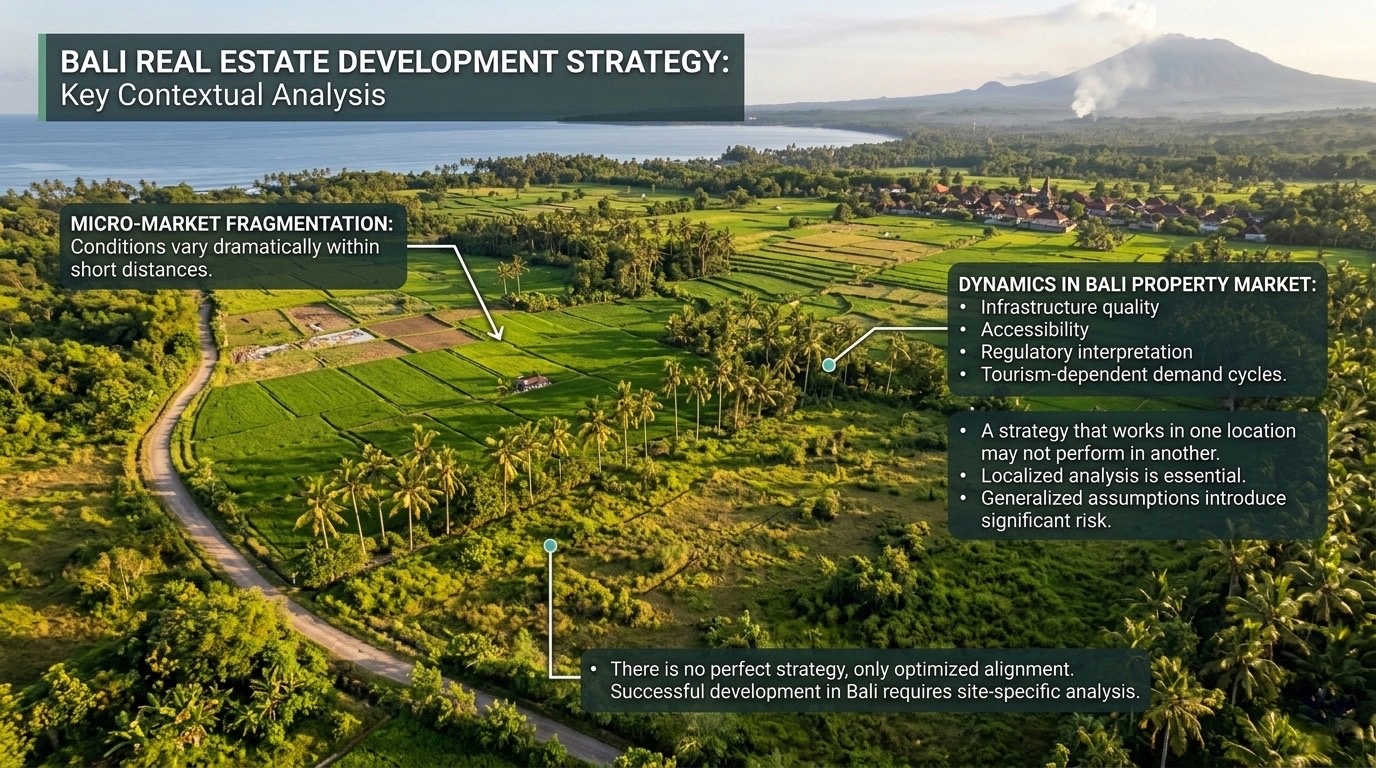
The island’s property market is characterized by micro-market fragmentation, where conditions can vary dramatically within short geographic distances. Infrastructure quality, accessibility, regulatory interpretation, and surrounding development patterns all influence how a project performs. Additionally, the market is closely tied to tourism cycles, introducing a level of demand volatility not present in more mature urban environments.
These factors mean that strategies cannot be generalized or replicated across locations. A concept that performs well in one area may underperform in another, even if the physical product is identical. As a result, successful development in Bali requires site-specific analysis and a willingness to adapt strategy based on local conditions.
In this context, strategy becomes less about applying a formula and more about interpreting a complex and evolving environment with precision.
‘Bali introduces additional complexity:
- Micro-market fragmentation
- Infrastructure variability
- Regulatory nuances
- Tourism-dependent demand cycles
Expanded Insight
- A strategy that works in one location may not perform in another.
- Localized analysis is essential. Generalized assumptions introduce significant risk, particularly in markets where conditions vary at a sub-regional level.
Every development involves trade-offs.
Common Trade-Offs
Decision | Benefit | Trade-Off |
Higher quality | Stronger pricing | Higher cost |
More amenities | Better marketing | Higher operations |
Faster build | Reduced delays | Quality risk |
Premium positioning | Higher margins | Narrow demand |
Additional Insight
- There is no perfect strategy, only optimized alignment.
- Projects fail when trade-offs are ignored or misunderstood.
FAQ
- What is a real estate development strategy and why is it important?
A real estate development strategy is the structured framework that defines what to build, who it is for, how it will be positioned, and how it will achieve financial performance. It is important because it aligns design, cost, and market demand before capital is committed, reducing the risk of misalignment that leads to underperformance. - At what stage should development strategy be implemented?
Development strategy should be established immediately after due diligence confirms that a site is viable. It must be completed before design begins, as early decisions determine cost structure, positioning, and feasibility outcomes. - How does development strategy differ from feasibility analysis?
Development strategy defines the optimal project structure, including asset type, unit mix, and positioning. Feasibility analysis evaluates whether that strategy is financially viable based on costs, revenue projections, and return metrics. Strategy defines direction; feasibility validates it. - What is the most common reason development strategies fail?
The most common reason is misalignment between product, market demand, and cost structure. This often occurs when projects are designed before strategy is defined, leading to assumptions that do not hold under real market conditions. - How should investors determine the right asset class?
Asset class should be determined based on market demand, pricing tolerance, location characteristics, and operational complexity. It should also reflect constraints identified during due diligence, ensuring that the chosen product can be realistically delivered and absorbed. - Why is unit mix critical to project performance?
Unit mix affects how quickly inventory is absorbed, how efficiently it can be constructed, and how stable revenue becomes over time. A focused mix of high-demand units typically outperforms diversified configurations with limited market appeal. - How does market positioning impact financial outcomes?
Market positioning determines pricing power, buyer expectations, and demand consistency. Projects with clear positioning are easier to sell and maintain pricing, while unclear or hybrid positioning leads to slower absorption and reduced returns. - How can developers effectively control costs from the beginning?
Cost control requires setting clear cost parameters early and aligning all design decisions to those limits. This includes selecting appropriate materials, simplifying systems, and avoiding over-specification relative to the target market. - What role do amenities play in a development strategy?
Amenities should support revenue generation or occupancy. They must be evaluated based on usage, operational efficiency, and contribution to pricing power. Amenities that do not meet these criteria often reduce overall profitability. - Can a project succeed without a structured development strategy?
Yes, but outcomes become unpredictable. Without a structured strategy, projects rely on assumptions rather than validated decisions, increasing the likelihood of cost overruns, slow sales, and reduced returns.
Conclusion
A high-performing project is not the result of isolated decisions, it is the result of a fully aligned Real Estate Development Strategy.
This alignment spans:
- Asset definition
- Inventory structure
- Spatial efficiency
- Market positioning
- Amenity strategy
- Cost control
Critically, this strategy does not exist in isolation. It is anchored by “investment best practices methodology” including due diligence, which defines what is possible, and validated by feasibility, which determines what is viable.
Developers who integrate these disciplines into a unified process gain a significant advantage:
- More predictable outcomes
- Stronger cost control
- Reduced exposure to risk
- Greater consistency in achieving target returns
Ultimately, Bali real estate development is not about reacting to market conditions. It is about structuring projects that perform regardless of them.
Our Development Feasibility article will continue you along in the Investment Advisory journey.