

Bali Property Due Diligence for Real Estate Investors and Developers

Introduction
Bali Property Due Diligence for Real Estate Investors and Developers is a multi-layered process that transforms uncertainty into a measurable risk profile and aligns investment decisions with reality. The first step in ensuring success with Real Estate Investment Advisory and Best Practices is to conduct a Due Diligence.
In markets such as Bali, where regulatory interpretation, infrastructure variability, and site-specific conditions introduce complexity, assumptions carry more risk. Investors operating without structured validation frameworks are not taking calculated risks, they are accepting unknown ones.
In professional real estate investment, outcomes are largely determined before construction begins. The decision to proceed or not proceed with a project is where capital is either protected or exposed. This is the function of due diligence. At its core, due diligence answers three critical questions:
- Is the project legally viable?
- Is it physically and technically executable?
- Does it meet required financial return thresholds?
Only when all three align should a project move forward.
Zoning & Buildability Verification
Zoning defines what can be built, how it can be built, and whether the intended use is legally permissible. It is the most binary variable in the entire development process.
What Must Be Verified
- Official zoning classification and permitted land use
- Maximum allowable building height and footprint
- Setbacks, easements, and buffer requirements
- Density limits and development intensity
- Environmental or culturally protected overlays
Where Investors Go Wrong
- Relying on verbal assurances instead of formal documentation
- Misinterpreting zoning classifications
- Assuming neighboring developments set precedent
- Failing to account for enforcement differences across regions
Professional Approach
Step | Action |
1 | Verify zoning through official government channels |
2 | Cross-check with independent local consultants |
3 | Align initial concept design with confirmed constraints |
4 | Document a formal build-ability report to be used in a Development Strategy |
Strategic Insight
- Zoning errors do not reduce returns, they eliminate them entirely.
- A project that cannot be legally built as intended has no path to recovery, regardless of design quality or market demand.
Infrastructure & Connectivity Status
Infrastructure is a foundational determinant of both feasibility and long-term asset performance. While often treated as secondary to land acquisition, it directly impacts cost, timeline, and user experience.
Core Infrastructure Categories
Infrastructure | Key Evaluation Criteria | Impact |
Road Access | Legal status, width, durability | Construction + usability |
Electricity | Load capacity, reliability | Operational continuity |
Water Supply | Source stability, scalability | Tenant/guest satisfaction |
Drainage | Flood risk, runoff management | Asset protection |
Internet | Speed, redundancy | Market competitiveness |
Common Miscalculations
- Assuming availability equals capacity
- Underestimating upgrade costs
- Ignoring long-term infrastructure strain
- Overlooking legal access rights
Best Practice Framework
- Conduct physical site verification, not just document review
- Confirm infrastructure capacity under peak usage scenarios
- Integrate upgrade costs into early financial modeling
Strategic Insight
- Infrastructure does not typically prevent development, but it redefines cost structures and can materially compress margins if not accounted for early.
Site Constraints


Every development site introduces constraints. The sophistication of an investor is reflected in how early and how accurately those constraints are identified.
Key Constraint Categories
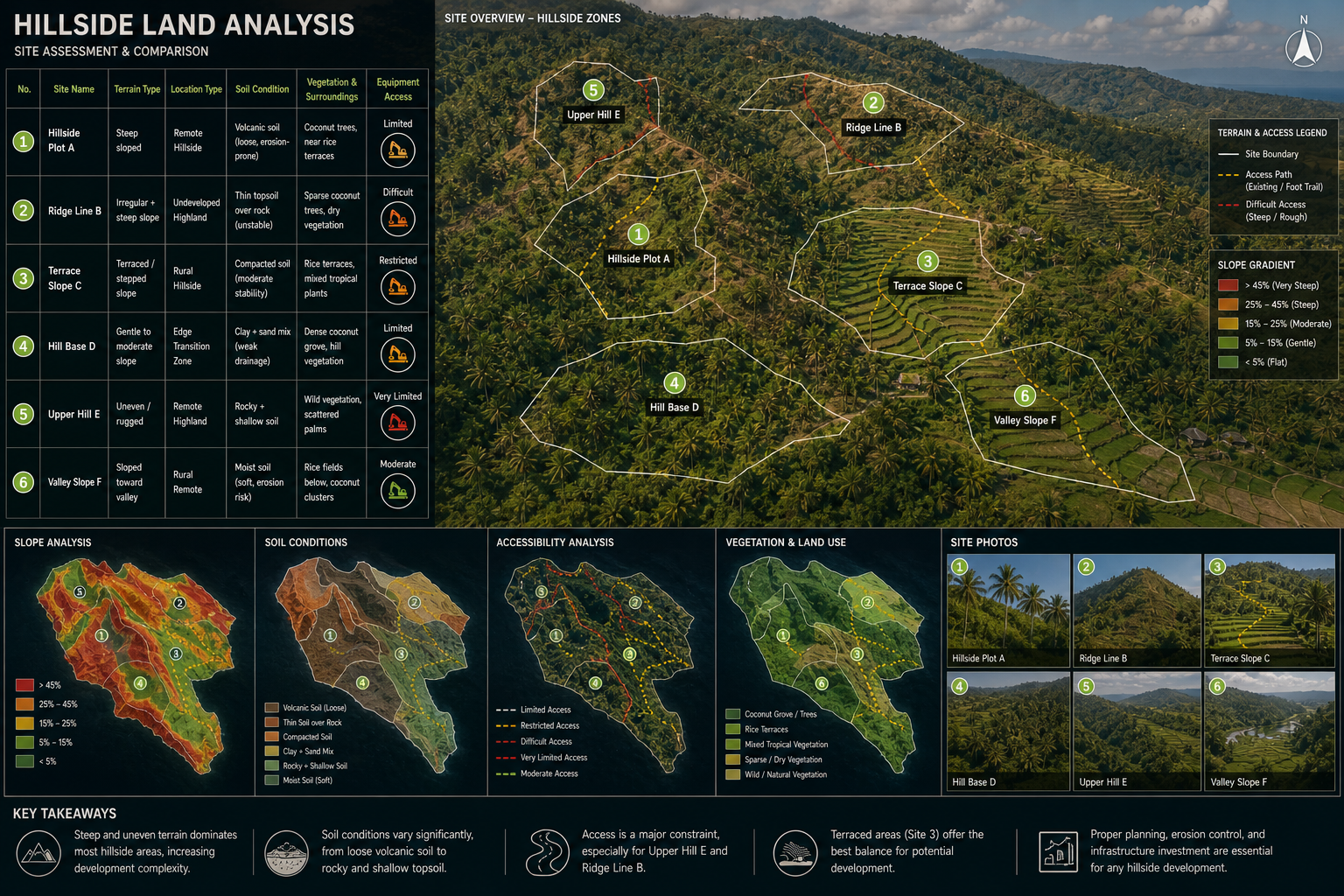
- Topographical challenges (slope, elevation variation)
- Soil conditions and geotechnical stability
- Flood zones and water table levels
- Legal encumbrances (easements, rights-of-way)
- Adjacency risks (noise, future developments, land use conflicts)
Constraint Mapping Model
Constraint | Severity | Design Response | Cost Impact |
Steep slope (>15%) | High | Terracing / structural support | High |
Weak soil | Medium | Foundation redesign | Medium |
Limited access | High | Road improvements | High |
Flood exposure | High | Elevation + drainage systems | High |
Implementation Standard
- Create a formal Opportunities and Limitations analysis
- Assign cost and design implications to each item
- Integrate findings into feasibility analysis
Strategic Insight
- Constraints are not inherently negative, but unidentified constraints become uncontrolled variables that erode budget and timeline predictability.
- Ensure all Due Diligence considerations are properly accounted
The “Red Tape” Roadmap
Regulatory processes are often viewed as unpredictable. In reality, they are structured, but only for those who map them correctly.
Approval Layers
- Land ownership compliance and transfer structure
- Development and construction permits
- Environmental and community approvals
- Operational licensing post-completion
Key Challenges
- Sequential dependencies between approvals
- Jurisdictional variations
- Informal vs formal processes
- Timeline uncertainty
Professional Methodology
Phase | Focus |
Pre-Acquisition | Identify all required permits |
Pre-Design | Confirm approval feasibility |
Pre-Construction | Secure core development permits |
Pre-Operation | Obtain operational licenses |
Common Errors
- Underestimating approval timelines
- Structuring ownership incorrectly for licensing
- Proceeding without full permit clarity
Strategic Insight
- Regulatory delays are rarely unexpected, they are simply unplanned.
- A structured roadmap converts regulatory complexity into a manageable timeline.
Land Preparation Cost Estimates
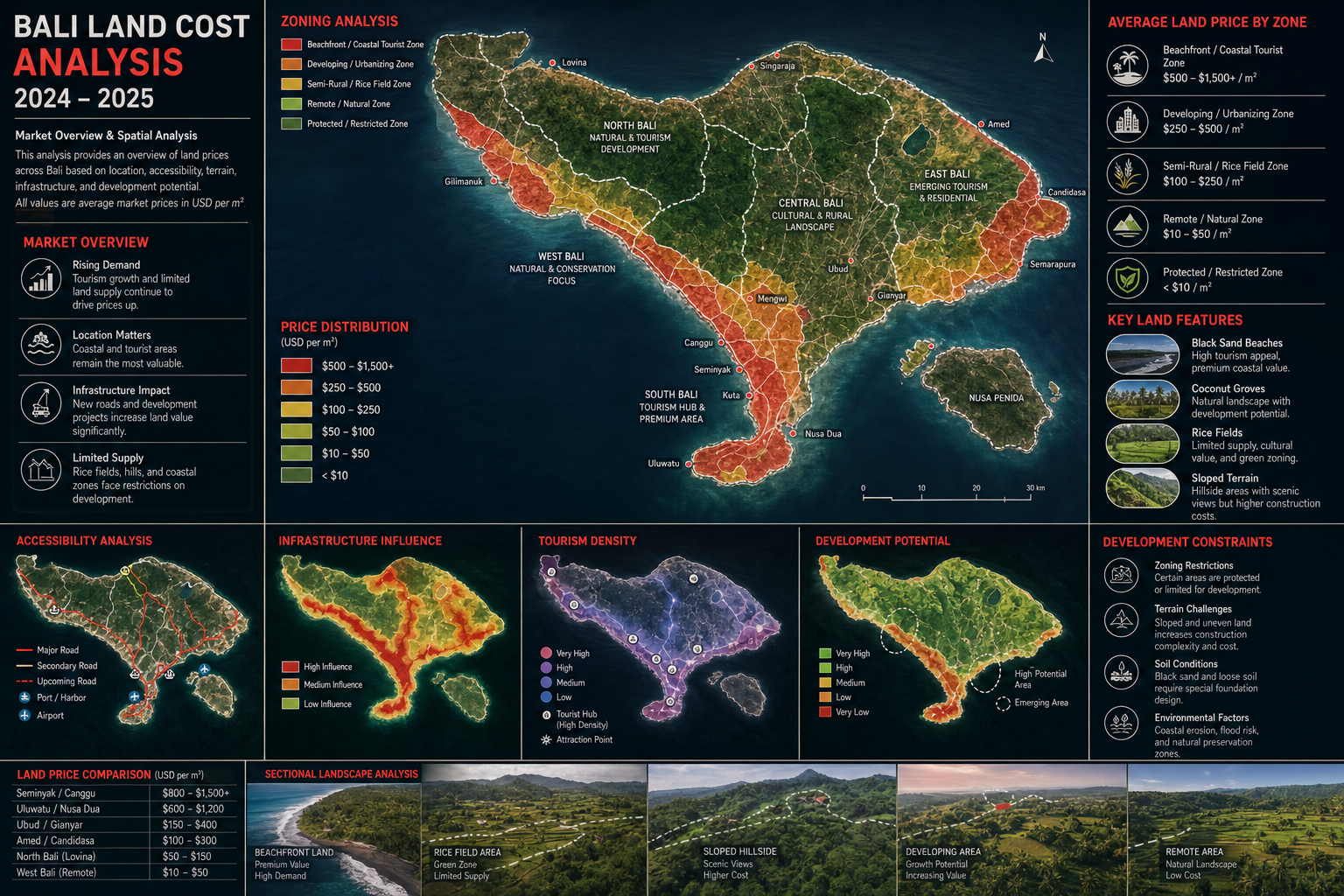
The acquisition price of land is only one component of total entry cost. Preparing land for development frequently introduces hidden capital requirements that materially impact feasibility.
Primary Cost Drivers
- Clearing and demolition
- Excavation and grading
- Retaining walls and structural stabilization
- Utility connections and upgrades
- Soil improvement measures
Typical Cost Distribution
Cost Component | % of Total Build Cost |
Clearing & Demolition | 3–8% |
Earthworks | 5–15% |
Utility Integration | 5–10% |
Structural Preparation | Variable |
Risk Indicators
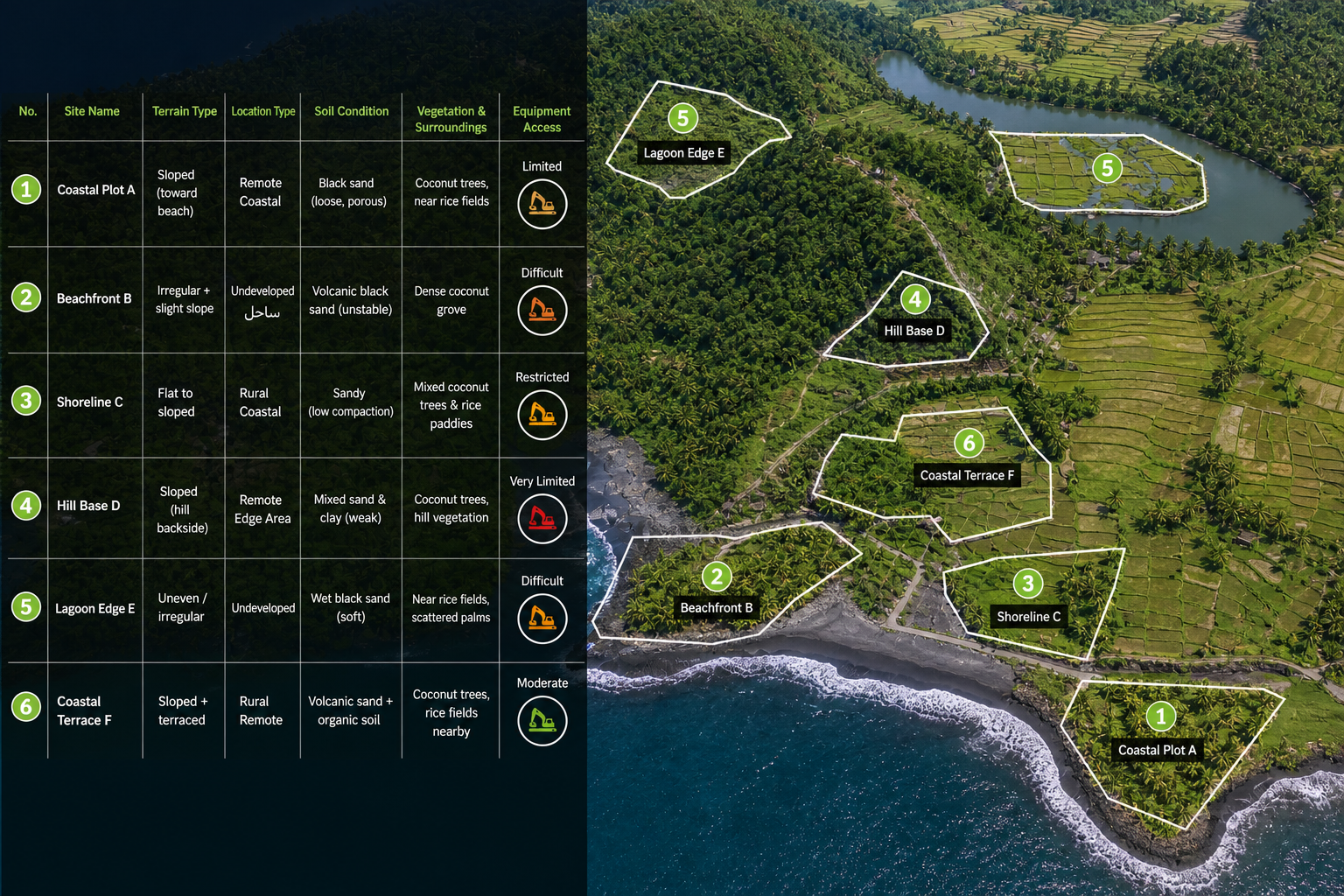
- Irregular or sloped terrain
- Remote or undeveloped locations
- Poor soil conditions
- Limited access for heavy equipment
Best Practice
- Conduct early-stage cost modeling
- Benchmark against comparable projects
- Include contingency allowances
Strategic Insight
- Inaccurate land preparation estimates distort the entire investment model, often leading to late-stage cost overruns that cannot be recovered.
Final Investment Verdict
All due diligence streams converge into a single decision: proceed, restructure, or reject.
Decision Framework
Outcome | Definition |
Proceed | Fully aligned across legal, technical, and financial metrics |
Restructure | Viable with adjustments to design, cost, or positioning |
Reject | Risk profile exceeds acceptable thresholds |
Professional Investor Behavior
- Applies predefined investment criteria
- Separates analysis from emotion
- Prioritizes downside protection
- Accepts deal rejection as a positive outcome
Strategic Insight
- The discipline to decline a project is often the defining characteristic of experienced investors.
- Execution skill does not compensate for a flawed entry decision.
FAQ
1. What distinguishes professional due diligence from basic property checks?
Professional due diligence is multi-disciplinary. It integrates legal verification, technical feasibility, infrastructure analysis, cost modeling, and regulatory mapping into a unified assessment. Basic checks confirm surface-level data, while professional due diligence challenges assumptions and stress-tests the viability of the investment. The difference is not depth alone—it is the ability to translate findings into decision-making clarity.
2. How long should due diligence take for a typical development project?
The timeline varies based on project complexity, but a structured process typically ranges from several weeks to a few months. Accelerating this phase often leads to incomplete analysis, increasing downstream risk. The objective is not speed—it is accuracy. Investors who compress due diligence timelines often encounter delays later in permitting, construction, or operations that far exceed any initial time savings.
3. Is it possible to fully eliminate risk through due diligence?
No. Risk cannot be eliminated—it can only be identified, quantified, and managed. Due diligence provides visibility into potential constraints and exposures, allowing investors to structure projects within acceptable risk thresholds. The absence of due diligence does not remove risk; it simply transfers it into the execution phase, where it becomes more costly and more difficult to resolve.
4. How does due diligence affect financing and investor confidence?
Comprehensive due diligence strengthens credibility with lenders and equity partners by demonstrating that risks have been systematically evaluated. Financial institutions and sophisticated investors prioritize clarity over optimism. A well-documented due diligence process aligns expectations, reduces perceived risk, and increases the likelihood of securing financing under favorable terms.
5. When should a project be rejected during due diligence?
A project should be rejected when fundamental constraints cannot be resolved within acceptable financial or risk parameters. This includes zoning incompatibility, excessive site preparation costs, legal ambiguity, or infrastructure limitations that materially impact feasibility. Early rejection is not a failure—it is a disciplined allocation of capital toward stronger opportunities.
6. What are the most commonly overlooked risks in Bali property due diligence?
The most overlooked risks are typically contextual rather than legal. These include infrastructure limitations such as access roads, drainage, and utilities, as well as environmental conditions and surrounding development patterns. Investors often validate ownership and zoning but fail to assess how the asset will perform operationally. These factors directly influence construction cost, usability, and long-term value.
7. How does zoning impact development potential beyond basic land use?
Zoning determines not only what can be built, but how efficiently it can be built. It influences density, building height, setbacks, and permissible use, all of which affect design flexibility and financial outcomes. Misinterpreting zoning constraints can lead to reduced sellable area, costly redesigns, or complete infeasibility. Professional due diligence translates zoning into practical development implications rather than treating it as a static classification.
8. Can due diligence identify future risks, or only current conditions?
Effective due diligence evaluates both present conditions and forward-looking risks. This includes planned infrastructure developments, competitive supply pipelines, and potential regulatory changes. While future outcomes cannot be predicted with certainty, structured analysis can identify likely scenarios and their impact on the project. This forward-looking perspective is critical for long-term investment performance.
9. How does due diligence influence development strategy?
Due diligence directly informs development strategy by defining the constraints and opportunities of a site. Legal conditions, physical characteristics, and infrastructure capacity all shape decisions around asset type, density, positioning, and cost structure. Without this foundation, strategy becomes speculative. With it, strategy becomes aligned with real-world conditions.
10. What level of detail should investors expect from a professional due diligence report?
A professional due diligence report should provide more than data—it should deliver structured insight. This includes clear identification of risks, quantified implications where possible, and a defined recommendation. The objective is to support decision-making, not simply to present information. If a report does not clearly indicate whether to proceed, adjust, or reconsider, it does not meet professional standards.
Conclusion
Due Diligence for Real Estate Investors and Developers is the most critical stage in the investment lifecycle. It is not simply about identifying risks, it is about structuring decisions with clarity and confidence. Only with this stage complete can a proper and complete Investment Analysis be crafted.
In markets like Bali, where variables are more nuanced and less standardized than in mature markets, the importance of this process increases significantly. Each site, each jurisdiction, and each project introduces unique conditions that must be evaluated independently.
Developers and investors who institutionalize due diligence gain a structural advantage:
- More predictable project outcomes
- Stronger cost control
- Reduced exposure to legal and operational risk
- Higher probability of achieving target returns
Ultimately, successful real estate investment is not defined by the number of projects executed, but by the quality of the decisions that initiate them.
Development Strategy is the next stage of our Investment Advisory journey.